1979 OIL CRISIS |
Introduction |
The photographs in this collection document the 1979 Oil Crisis as it played out on the streets of Los Angeles. They show the long lines, empty pumps, and handwritten signs that became familiar sights across the Southland during one of the most disruptive energy emergencies in American history. Together, they offer a street-level view of a city and a nation dealing with sudden scarcity.
|
The Shock to the System |
The 1979 Oil Crisis was the second major energy disruption of the decade, following the 1973 Arab Oil Embargo. Its origins were in the Iranian Revolution, which swept the country beginning in late 1978 and ended with the fall of the Shah in January 1979. As the political order collapsed, some 37,000 Iranian oil refinery workers went on strike, cutting the country's output from roughly 6 million barrels per day to about 1.5 million. The resulting 7 percent drop in global supply sent oil prices sharply upward.
|
 |
|
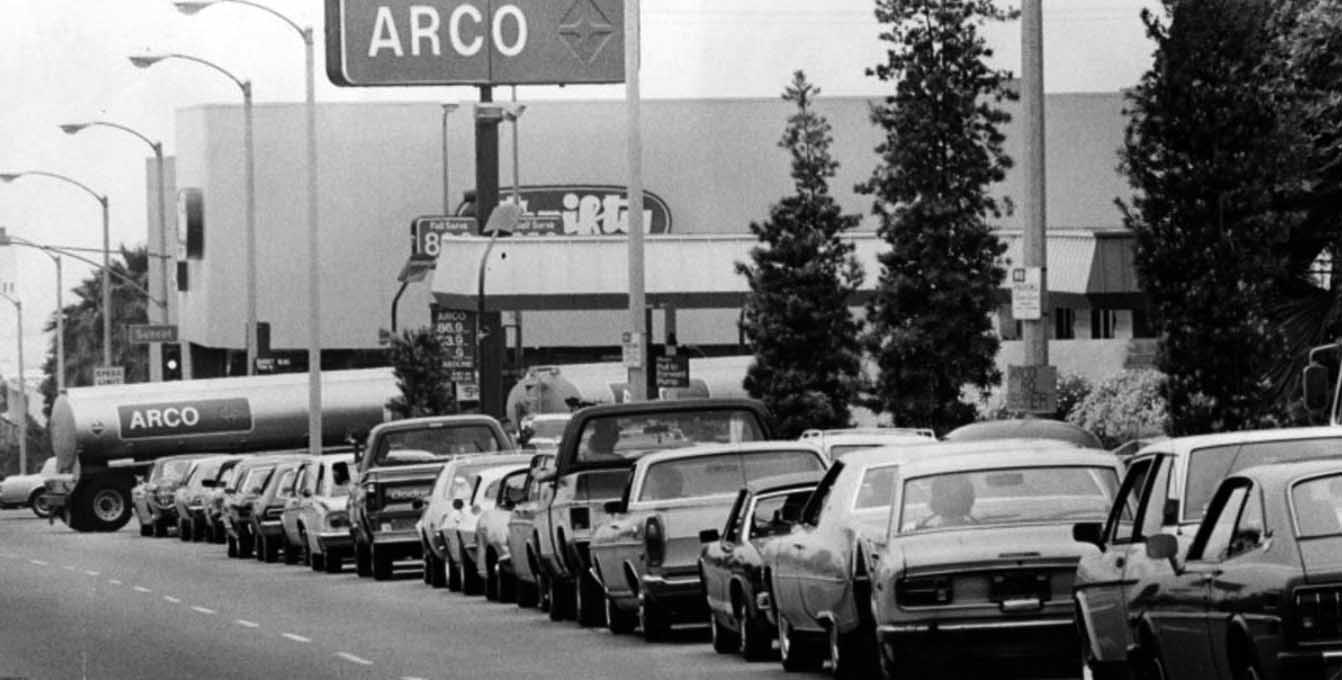
| (1979)* – Lines form at the ARCO station on the northwest corner of Sunset Boulevard and Fairfax Avenue during the 1979 Oil Crisis. A gasoline tanker cuts through the queue of waiting cars. |
| Historical Notes
The intersection of Sunset Boulevard and Fairfax Avenue was a busy commercial area in 1979, and the ARCO station there became a pressure point as drivers from across the surrounding neighborhoods converged looking for fuel. The tanker truck visible in the photograph illustrates a recurring tension of the crisis: deliveries were irregular, and the arrival of a tanker could draw dozens of additional cars within minutes, deepening the lines rather than clearing them. ARCO had moved away from full-service operations in the 1970s as a cost-cutting measure, making self-service pumping common well before the crisis struck. The station is no longer present at this location. |
Waiting in Line |
Across Los Angeles, the daily task of fueling a car became an exercise in patience and anxiety. Lines stretched for blocks, drivers idled for an hour or more, and stations sometimes ran dry before the last car in line reached the pump. For a city with no meaningful public transit alternative, the inability to buy gasoline was not merely an inconvenience. It threatened commutes, deliveries, and the routines of daily life.
|
 |
|
| (1979)* – The last car in line at the Standard Oil station at Olympic Boulevard and Hope Street displays a sign alerting approaching drivers that no fuel is available. Suppliers barely met demand as drivers lined up at pumps across Los Angeles. |
| Historical Notes
The improvised sign system shown here was one of the more considerate responses to the crisis at the street level. Rather than letting drivers wait in line only to reach an empty pump, attendants would walk to the back of the queue and post a notice so late arrivals could turn around and look elsewhere. It was a small act of courtesy in a situation that frequently produced the opposite, as drivers argued over spots in line, siphoned gas from parked cars overnight, and filled containers well beyond what they needed. The Standard Oil station at Olympic Boulevard and Hope Street stood at the western edge of downtown Los Angeles, in a district that then mixed light industry, offices, and residential buildings. The station has since been replaced by the Renaissance Tower Apartments, a residential high-rise that now occupies the corner of Olympic Boulevard and Hope Street. |
Rationing and Adaptation |
As lines lengthened and supplies remained unpredictable, state and local governments moved to manage demand through formal rationing. California was among several states, including Pennsylvania, New York, New Jersey, Oregon, and Texas, that adopted odd-even rationing systems. Under the rules, drivers with license plates ending in an odd number could only purchase fuel on odd-numbered calendar days. Even-numbered plates were restricted to even days. The system was the same one California had used during the 1973 Oil Crisis.
|
 |
|
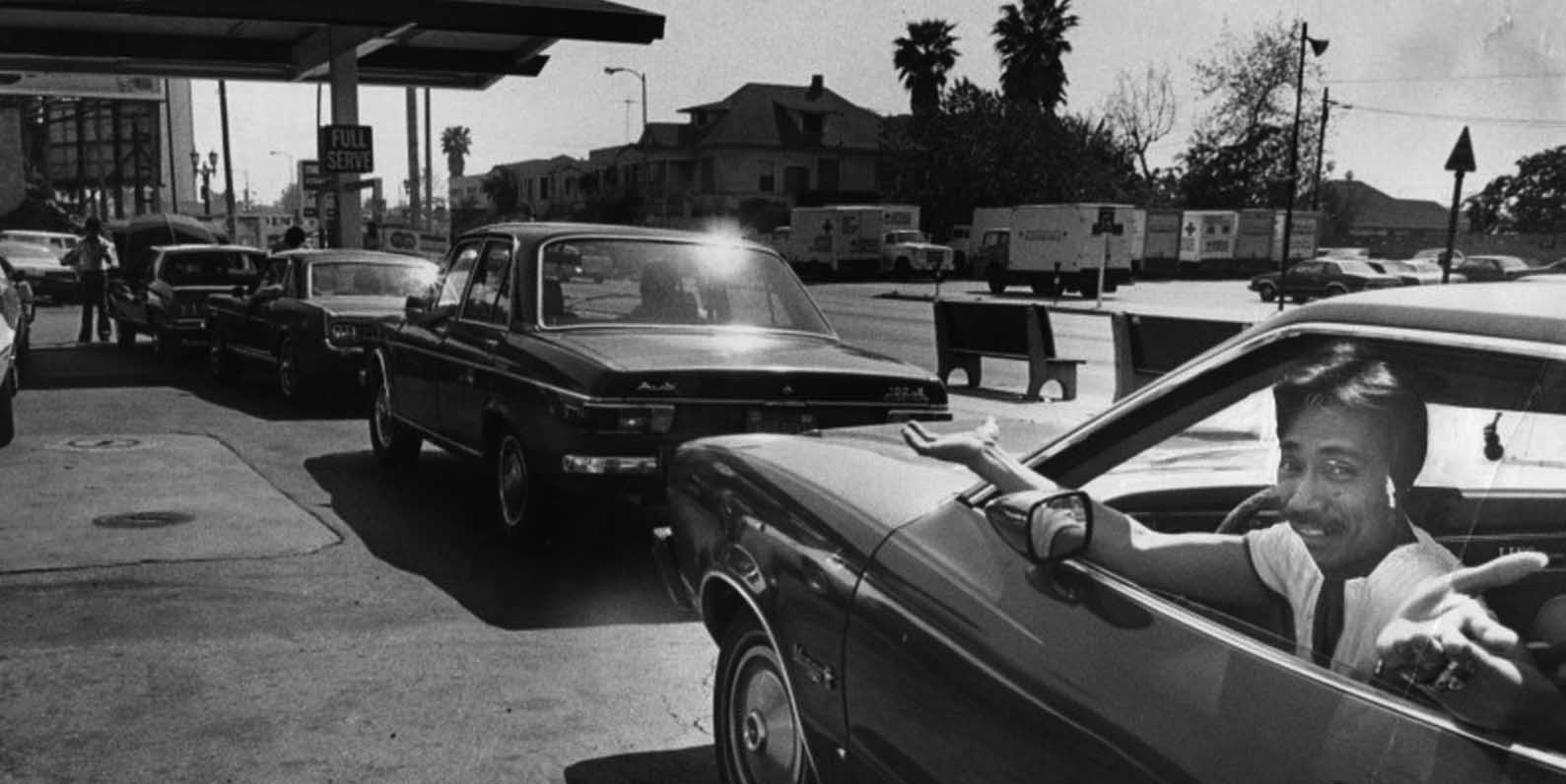
| (1979)* – L.A. resident Pil Des Jesus poses with arms spread from the driver-side window of his Ford Mustang while waiting in line at a 76 Station at Vermont Avenue and Olympic Boulevard. An Audi 100 LS awaits service ahead of him. |
| Historical Notes
The 76 Station at Vermont Avenue and Olympic Boulevard served a densely populated neighborhood in South Los Angeles. The photograph was taken ahead of a holiday weekend, capturing the particular anxiety of the crisis: the fear that a station would run dry before a driver could reach the front of the line. Holiday weekends produced some of the longest lines of the entire crisis period, as drivers tried to fill up before traveling. The Ford Mustang in the foreground and the Audi 100 LS visible ahead represent the range of vehicles Americans were driving in 1979, many of them far less fuel efficient than the smaller cars Detroit would begin producing in response to the crisis. |
 |
|
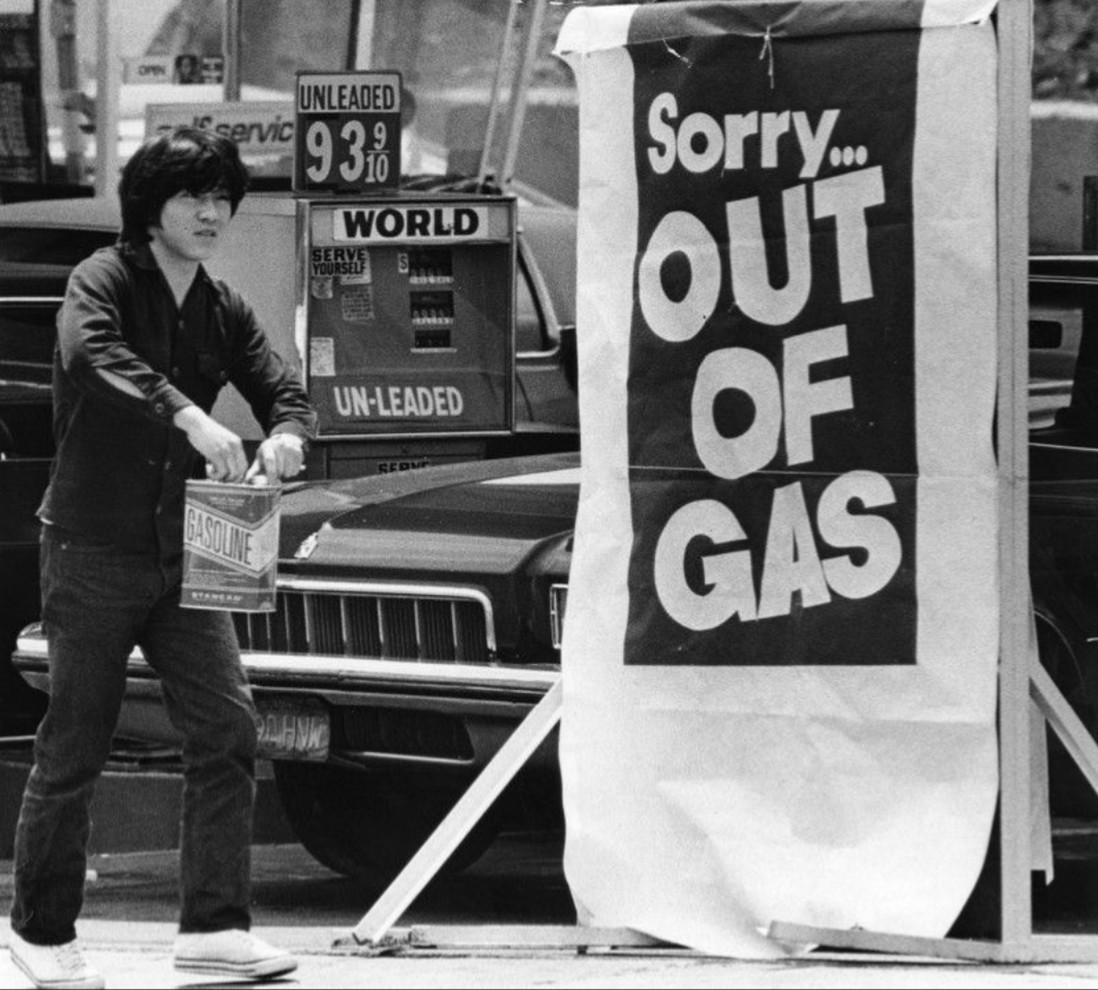
| (1979)* - A man carries a gasoline canister across the lot of the World Gas Station on La Brea Avenue toward a large sign reading Sorry ... Out of gas. |
| Historical Notes
Carrying a portable gasoline canister became a practical workaround for some Angelenos during the crisis. Rather than waiting in line at a dry station, a driver might walk or bicycle to a station that still had fuel, fill a container, and carry it back to the car. It was a small but telling sign of how people adjusted their behavior when a system they had always taken for granted stopped working reliably. La Brea Avenue, which runs through the Miracle Mile district, was lined with service stations that served both local residents and through traffic. Because of that heavy combined demand, stations along La Brea were often among the first in the area to exhaust their supply when tanker deliveries fell behind. The Sorry ... Out of gas sign in the photograph was a common sight along commercial corridors throughout the Southland in the spring of 1979. |
When the Pumps Ran Dry |
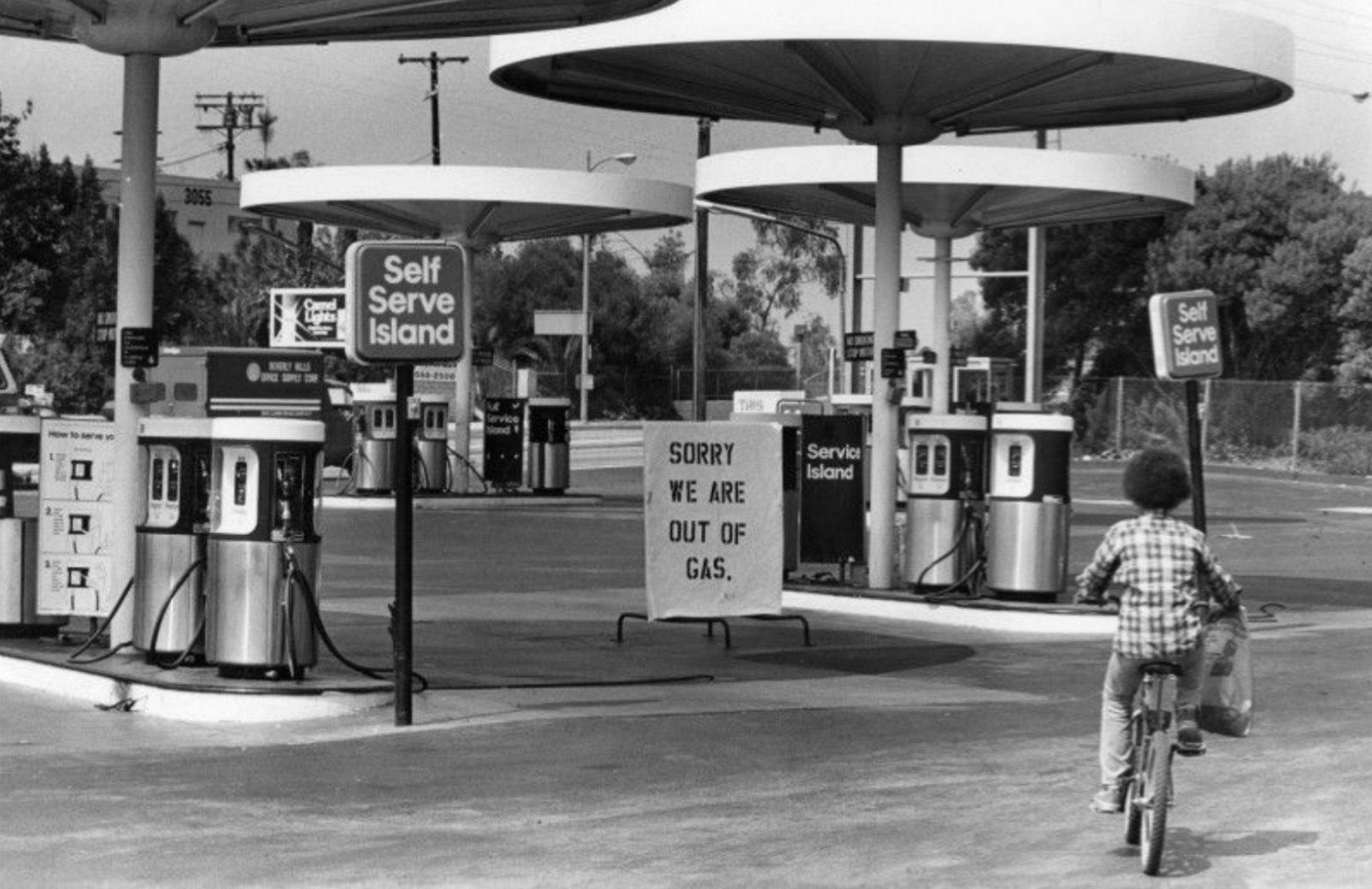
Some stations did not merely run low. They shut down entirely. When a station exhausted its supply and could not get a delivery date, the owner would pull the pump handles, lock the canopy doors, and post a sign. The empty station became one of the defining images of the crisis: a place built for constant motion and commerce, suddenly still and silent.
|
 |
|
| (1979)* - A young boy rides his bicycle through the empty lot of an out-of-commission Mobil station at Overland Avenue and National Boulevard in the Palms neighborhood of West Los Angeles. |
| Historical Notes
The Mobil station at Overland Avenue and National Boulevard was located in Palms, a residential neighborhood on the Westside of Los Angeles. The photograph was taken in late March 1979, during one of the earliest and most severe phases of the crisis, before the Carter administration's deregulation measures had time to increase domestic supply. The boy on the bicycle gives the image its quiet power: the station, ordinarily a place of adult transactions and engine noise, has been taken over for a moment by someone with no need for gasoline at all. The Mobil brand, then one of the most widely recognized oil company names in the United States, merged with Exxon in 1999 to form ExxonMobil. |
| Aftermath
The crisis eased gradually through 1980 and 1981. The Carter administration's phased deregulation of oil prices, begun on April 5, 1979, encouraged increased domestic production, particularly from the Prudhoe Bay fields in Alaska, while oil imports fell sharply. A global recession reduced demand, and Saudi Arabia increased output to help stabilize markets. By the mid-1980s, oil prices had returned to levels near those of the early 1970s, and the long lines had become a memory. The lasting effects were significant. Congress tightened federal fuel economy standards for automobiles, and American carmakers accelerated development of smaller, more efficient models. Investment in domestic energy production increased, and the crisis deepened a national debate about dependence on foreign oil that continued for decades. Odd-even rationing programs were quietly discontinued, and the federal gasoline ration coupons that had been printed but never used were eventually destroyed. For Los Angeles, the events of 1979 left a lasting impression. A metropolitan region built around the automobile and the freeway had been forced to confront the limits of that model. The images in this collection preserve that moment of reckoning, the lines, the signs, the empty lots, as a reminder of how quickly the rhythms of daily life can be disrupted by forces originating far from home. |
A Crisis Revisited — 2026 |
The photographs in this collection were taken nearly fifty years ago, but the story they tell is unfolding again. In late February 2026, the United States and Israel launched military strikes on Iran, and Iran responded by effectively closing the Strait of Hormuz, the narrow waterway through which roughly one-fifth of the world's daily oil supply passes. Within a week, crude oil surpassed $100 per barrel for the first time since 2022, and gasoline prices at American pumps jumped nearly fifty cents a gallon. The International Energy Agency called it the greatest energy security challenge in the agency's history, a supply disruption three times larger in raw volume than either of the 1970s oil shocks that produced the long lines visible in these photographs. The parallels are hard to ignore. In 1979, it was the Iranian Revolution that disrupted production and sent prices spiraling. Today, it is a war involving Iran that has closed the route through which most of the region's oil moves. Both crises triggered immediate price spikes, panic buying, questions about rationing, and a sudden awareness of how fragile the connection between distant oil fields and the local gas station actually is. Parts of Asia have already instituted fuel rationing programs. Europe is facing its second major energy crisis in four years. And as in the 1970s, the pain at the pump is spreading into food prices, transportation costs, and the broader economy, because oil is not just fuel. It is embedded in fertilizer, plastics, packaging, and nearly everything that moves. What remains uncertain is how long the disruption will last and how far the damage will spread. The United States is more energy independent today than it was fifty years ago, and strategic reserves exist now that did not then. But those reserves cannot compensate indefinitely for a chokepoint handling twenty million barrels a day. The people waiting in line at the ARCO station on Sunset and Fairfax in 1979 could not have imagined that the same country, Iran, would be at the center of another global energy crisis in their lifetimes. History does not repeat exactly, but it has a long memory. |
* * * * * |
|
Other Sections of Interest |
|
Water and Power in Early LA |
|
Newest Additions |
New Search Index |

A new SEARCH INDEX has been added to help navigate through the thousands of topics and images found in our collection. Try it out for a test run.
Click HERE for Search Index |
* * * * * |
< Back